

 Call us:



The Skills that Shape Success
𝐏𝐫𝐞𝐩𝐚𝐫𝐢𝐧𝐠 𝐒𝐭𝐮𝐝𝐞𝐧𝐭𝐬 𝐟𝐨𝐫 𝐋𝐢𝐟𝐞 𝐁𝐞𝐲𝐨𝐧𝐝 𝐄𝐱𝐚𝐦𝐬, 𝐌𝐚𝐫𝐤𝐬, 𝐚𝐧𝐝 𝐌𝐞𝐦𝐨𝐫𝐢𝐬𝐚𝐭𝐢𝐨𝐧.
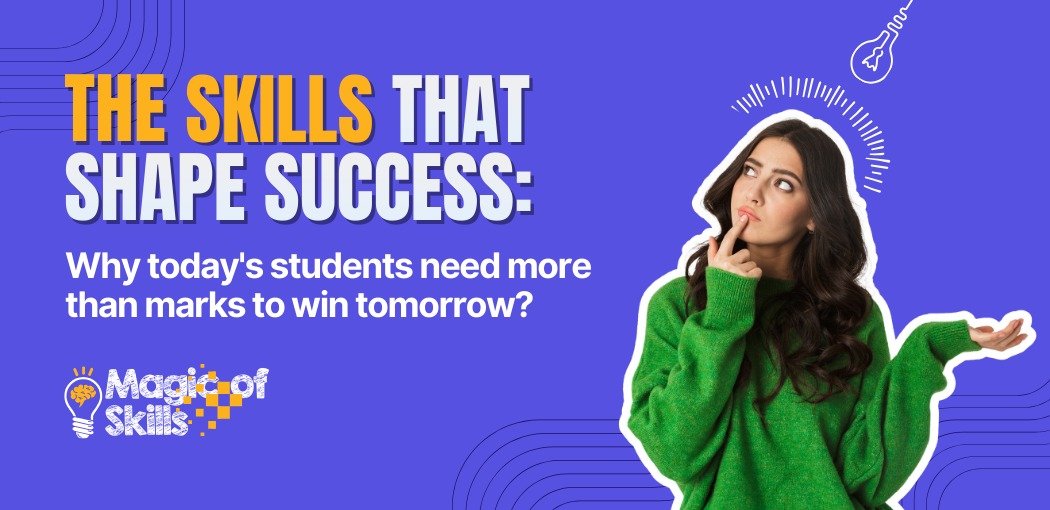
The Skills That Shape Success: Why Today’s Students Need More Than Marks to Win Tomorrow
Walk into any school corridor today, and you’ll notice something striking. Students are dreaming bigger than ever, with careers in AI, filmmaking, entrepreneurship, design, innovation, content creation, space science, and countless fields that didn’t even exist a decade ago. But behind these dreams lies a question every parent, educator, and school leader quietly wonders:
Are we preparing learners for what truly awaits them beyond the classroom?
Because the truth is simple, academics alone are no longer enough.
The World Has Changed… and So Must Learning
There was a time when high marks guaranteed a good future. But in today’s world, the rules have changed. students who thrive are not just the ones who memorize;
They are the ones who can
💡 Think critically
🗣️ Communicate confidently
🤝 Collaborate effectively
🎨 Create with imagination
⚡ Adapt quickly and solve problems
These are skillsnot subjects. And they are shaping the future more powerfully than ever before. So, now the conclusion a student who learns to speak confidently can ace an interview. A student who thinks creatively can build solutions that no textbook offers. A student who leads well can transform a classroom, a community, or eventually a company.
Why Skill Development Is No Longer Optional
Across the world, top universities and global companies now look beyond report cards. They are searching for something else, the real capabilities behind the marks. And interestingly, the most in-demand skills today are not technical alone.
They are human skills.
They are future skills.
They are life skills.
1. Creativity & Innovation
From startups to classrooms, creativity is currency. Students who can think differently stand out everywhere.
2. Communication Skills
Whether a child becomes a doctor, engineer, designer, or entrepreneur, communication defines impact.
3. Critical Thinking
AI can give answers. But students need to know how to ask the right questions.
4. Emotional Intelligence
Handling pressure, working in teams, and understanding others are make-or-break abilities.
5. Problem-Solving & Decision-Making
The world rewards students who can figure things out, not just write them down. these skills help students not only in careers but also in daily life, friendships, leadership roles, competitions, and confidence.
How Skill Development Transforms Students at Home, School, and Beyond
Something magical happens when a child starts developing real-world skills:
- A shy child begins speaking up.
- A confused teen gains direction and clarity.
- A student who doubted themselves finally discovers what they’re good at.
- A classroom becomes more collaborative, engaging, and positive.
Teachers often report that once students build these skills, discipline improves, participation increases, and learning accelerates naturally. Parents, on the other hand, see a difference at home, more confidence, better decision-making, sharper thinking, and improved emotional balance.
And for students…
Skill development feels empowering. It gives them a sense of identity. It makes them feel capable and excited about the future.
A New Era of Learning: One Platform, Unlimited Growth
Schools today are shifting from “teaching for exams” to “preparing for life.” And that’s exactly where skill-based learning steps in. This is also the space where Magic of Skills works, helping schools bring structured skill development programs to students from Classes 4 to 12, covering areas like communication, public speaking, creativity, innovation, design thinking, leadership, and more. Because modern education isn’t about replacing academics, it’s about enhancing them. When students become confident thinkers, creators, speakers, and leaders, they perform better not only in career paths but in academics, too.
The Future Belongs to Skilled Students
The earlier a student begins building skills, the stronger their foundation becomes.
A child who learns communication in Class 4 will speak fearlessly in Class 12.
A student who learns creativity in middle school will be more likely to innovate in future workplaces.
A teen who learns emotional intelligence today will handle tomorrow’s world with maturity.
We no longer prepare students for exams. We prepare them for life, and life is bigger than marks.
The next generation will compete not for degrees, but for abilities. The winners will be those who can think, speak, create, lead, adapt, and innovate. And that journey begins early.
It begins now.
It begins with skills.
Because marks show what a student has learned, but Skills show what a student can do. And in the real world, doing makes all the difference.
“ Marks measure learning, but skills determine success. The future belongs to students who can think, speak, create, and lead.”